Monday, 27 June 2016


"Eternal truths are ultimately invisible, and you won't find them in material things or natural phenomena, or even in human emotions"


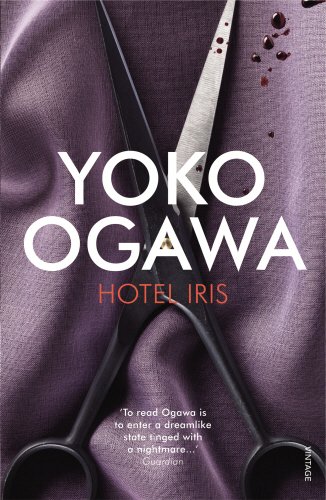
Off the back of Han Kang's brilliant and unique The Vegetarian I wanted to dip back into the work of South East Asian women writers and came across this novella from Yoko Ogawa. At only 173 pages this is a wonderfully concise slice of Japanese fiction translated into English by Stephen Snyder who has previously translated works for both Ogawa, Natsuo Kirino and Ryu Murakami.

Checking in to Hotel Iris is disturbing in itself. The mouldy and damp hotel crumbles in a forgotten sea-side resort somewhere in Japan managed by a cruel matriarch with her young daughter Mari forced to work on the reception. Out of season the hotel attracts unlikely guests such as a blind pensioner who is switched from a room with a sea view to one without on arrival. 

Mari is essentially trapped in a world entirely controlled by her mother until one day there is a ruckus in the hotel when a prostitute bursts from one of the bedrooms accusing a elderly guest of being violent towards her. Despite her mothers clear disgust Mari is drawn to the elderly man and begins to chat with him days later in the market.

The translator, as he is referred to, lives in an isolated house on a nearby island where he translates books into Russian. The attraction here to Mari is clear, over the water lies another world filled with everything that is missing from the Hotel Iris. 

As Mari gets to know the translator their relationship grows and once Mari enters his world she is subjected to a brutal attack. The incident leaves Mari questioning everything but she continues to see the Translator with a bizarre coming of age fascination. Like The Vegetarian, these passages are hard to read but strangely addictive.

There is no doubt that this book will speak to each reader in a unique way. For me Ogawa's story is about how tough and complicated the world outside can be. The chapter including the dinner party with the Translator's nephew I think beautifully captures the experience of reading the novel; unnerving and unforgettable.

I read this novel in paperback in June 2016 in part on the Southbank of the Thames.

Hotel Iris by Yoko Ogawa, published by Vintage, 173 pages


"Nine minutes to five. Ozone and sea sparkle and carnival licence. This is how it begins"


The Pier Falls is a new short story collection from Mark Haddon. Having already mastered the long form novel with The Curious Incident of the Dog in the Night-time, amongst others, this is the first test of Haddon's skills with the tricky short story format.

The book itself contains a number of shorts with no discernible thematic or narrative link as such but each story demonstrates the limitless imagination of a writer who transports us from the everyday to the mythical and the extraordinary with equal skill. For the purpose of this review I'll focus on the first story The Pier Falls.

The Pier Falls presents a classic diorama of the traditional British seaside holiday; fish and chips, striped deck chairs and screeching sea gulls; you can almost taste the pink candy floss. This instantly recognisable backdrop is steeped in nostalgia and longing for a simpler time. Reading the story on the Harbour Arm in Margate I looked back at the town and saw the bleached out orange and sun-burnt red colours exactly as they are shown on the vintage deck chair cover of the novel. 

As the story develops its like a seaside View-Master reel; each click reveals more in vivid day-glo 3D. The perfect summer day at the seaside turns into tragedy as the very foundations of the crowded pier begin to crumble. Bolts fly as metal supports tumble into the sea and shards of wood separate screaming families. Haddon doesn't hold back in descriptions of adults and children falling from the pier into the water. The death count builds quickly yet the narrative continues at pace with little respite. Haddon knows exactly how to create heart stopping tension in only a few sentences, you'll be literally holding your breath.

For me The Pier Falls is an allegory not so much for the end of the British holiday but for the end of nostalgia for the past. Its a great read and a monumental introduction to the other stories in the collection. Read them once then start over again for maximum enjoyment.

I bought this particular book in hardback largely due to the individual illustrations that accompany each story. Good on Mark Haddon for making these brilliant line drawings and for including them specifically in this book shop only edition. 

I read this novel in hardback in June 2016 in part in Margate.

The Pier Falls by Mark Haddon, published by Jonathan Cape, 336 pages


Sunday, 19 June 2016


"D-E-L-U-S-I-O-N-A-L. Eleven points plus fifty point bonus"


Epiphany Jones is the debut novel from American journalist and novelist Michael Grothaus. Whilst the book will no doubt be shelved under 'Crime thrillers' in bookshops Epiphany Jones in truth is a unique genre blurring novel that cleverly weaves together a criminal investigation, wildly dark humour and psychologically driven misadventure.  The novel holds no punches; sex trafficking, the seedy Hollywood underworld, art theft, psychotic hallucinations and kidnapping this book has it all, but is there any sense behind Epiphany Jones?

Our protagonist is Jerry, a guy struggling to come to terms with a traumatic past, who is suspected of stealing a priceless Van Gogh painting from the museum in which he works as a picture restorer. Forced underground he meets a mysterious woman, Epiphany Jones, who is utterly beguiling to the loner and online porn addicted Jerry.  

The couple end up on the run to Mexico and then across the Atlantic to Portugal before landing at the Cannes film festival. The plot is fast paced and packed full of episodes that develop the unlikely relationship between Jerry and Epiphany who believes the voices she hears in her head are from God himself. With Jerry fighting his own deep bouts of depression and hallucinations you'd be forgiven for wondering where the comedy lies yet in amongst this challenging set of circumstances Grothaus finds deeply dark and welcome humour. 

Michael Grothaus's talent is creating a world populated by initially unlikable characters that end up being completely readable. At times I thought of Douglas Coupland in books like Worst. Person. Ever. Likewise the backdrop to the story which exposes the dark underbelly of Hollywood is reminiscent of Bret Easton Ellis's work in Glamorama and Imperial Bedrooms; explicit, raw and unnerving.

There's is no doubt that this novel is memorable and Grothaus absolutely delivers a new voice in a crowded genre but the trouble I have with Epiphany Jones is that, whilst the characters are well drawn and believable, I found it pretty difficult to connect emotionally. Despite this, there is a lot, and I mean a lot, going on in this story which keeps you guessing right to the end.

For me the real genius in this novel is the bringing together of unconventional characters in a narrative around mental health issues and serious crime.   

I read this novel in paperback in June 2016 in mostly at home in Thame, Oxfordshire.

Epiphany Jones by Michael Grothaus, published by Orenda Books, 340 pages


Saturday, 11 June 2016


"I have no roots, he thought. I'm not connected to anything"


after the quake is a collection of short stories by Haruki Murakami which all deal in some way with the aftermath of the devastating Great Hanshin earthquake which hit the Japanese port of Kobe on January 17 1995. Each story is set within a month of the earthquake at a time when the entire country was reflecting on the huge loss of life and livlihood including Murakami's own parents who lost their home in the disaster.

There are 2 standout short stories within this collection, Super-Frog Saves Tokyo and Honey Pie, which both demonstrate a different Murakami trope; firstly the whimsical and supernatural and secondly the theme of the lonely adult.  

In Super-Frog Saves Tokyo young bachelor Mr Katagiri returns home from work to find a giant and highly articulate frog waiting for him. Frog explains to the unassuming Mr Katagiri that his help is needed to battle a giant worm who is set to unleash a second earthquake, this time on Tokyo itself. In this story Murakami typically makes overt references to other literature, the opening scene is both Kafka and Manga-esque in itself, and other writers such as Hemingway and Tolstoy who are both mentioned by Frog to convince Mr Katagiri that it is his obligation to help in the battle with Worm. Mr Katagiri is the 'everyman' jolted out of his everyday routine and forced to face a life changing challenge. There is a sense here of Murakami himself exploring his own role in repairing the battered Japanese psyche.

In Honey Pie (another story named after a Beatles song following Norwegian Wood) Murakami writes about a college love triangle and a young girl haunted at night by The Earthquake Man. Murakami's skill as a writer of short stories is evident throughout Honey Pie which includes a story within a story, which protagonist Junpei reads to the young girl, aswell as a flashback to college life which sets up the relationship between Junpei and his friends. This theme of the lonely and isolated adult coming to terms with decisions made in the past is classic Muramaki but in Honey Pie the overarching theme is one of hope. Building on the idea of Murakami questioning his own role as cultural guide in Super-Frog Saves Tokyo, in Honey Pie we find an example of Murakami offering solutions and faith.

The fact that there is so much to say about only two of the stories in this collection demonstrates just how good a read this is. Admittedly some context is required to fully appreciate the stories but this is exactly where reading digital books is an advantage. There are times when you'll want to delve into Wikipedia to drill down into information about Murakami himself and about the Kobe earthquake. Some readers find this distraction an anathema to reading literature but for me its a open door to more layers of meaning. 

I read this collection of short stories on Kindle in June 2016 in part at the St David's Hotel at Cardiff Bay.

after the quake by Haruki Murakami, published by Vintage Books, 162 pages


Thursday, 2 June 2016


#amreading 'The Vegetarian' by Han Kang


"The sight of her lying there utterly without resistance, yet armoured by the power of her own renunciation, was so intense as to bring tears to his own eyes"

This year's Man Booker International Prize winner is a truly memorable novel by South Korean writer Han Kang whose work has been translated into English, for the first time, by Deborah Smith.

I'm a huge fan of Japanese literature from the likes of Murakami, Banana Yoshimoto and  Hiromi Kawakami, but had never read a Korean novel before largely as they are much less frequently translated into English than Japanese titles. I approached the novel with expectations based on reading novels like The Lake and Strange Weather in Tokyo and inevitably wondered what sort of influence Japanese literature would have had on Korean writers but I was also intrigued by Deborah Smith who was making her debut as a translator.

The Vegetarian is a novel in three chapters, in fact they were each published as separate novellas originally. The story concerns the heroine Yeong-Hye an average and unremarkable house-wife who one day decides to empty the freezer of meat; declaring herself to be vegetarian.

The opening chapter is a first person narrative from the perspective of Yeong-Hye's husband, Mr Cheong, who struggles to deal with his wife's new resolve. How will he cope when his wife accompanies him to dinner with his boss? Desperate for help he invites Yeong-Hye's family to dinner to where her father violently forces his daughter to eat a piece of pork - this is visceral and unfaltering writing that is innately uneasy to read.

The second chapter concerns Yeong Hye's brother-in-law who becomes obsessed with Yeong-Hye's body once he discovers that she is concealing a distinctive birthmark - a Mongolian Spot. The final chapter is set several years in the future when Yeong-Hye has lost contact with her entire family apart from her sister In-Hye who visits Yeong-Hye in a psychiatric hospital.

This is a novel about a family in crisis born out of one member no longer being willing to conform to social and societal norms. Han Kang expertly structures the novel around the three long chapters that explore the voices around Yeong-Hye. Though the narrative is never hers, Yeong-Hye remains the focus of the novel throughout.

Each chapter features dream sequences which blur the everyday and ethereal and provide the reader with rich and dynamic prose. The fact that these sequences work so well in The Vegetarian is a huge credit to the work of Deborah Smith who achieves a translation that is wonderfully readable in English whilst at the same time profoundly different to English language novels.

Off the back of reading this novel I'm sure I won't be alone in seeking out more Korean fiction and certainly more from the Han Kang/Deborah Smith partnership.     


I read this novel on paperback in May 2016 in West Malling, Kent

The Vegetarian by Han Kang and translated by Deborah Smith, published by Portobello Books, 160 pages

Monday, 30 May 2016


"Things like this weren't supposed to happen in Iceland, the most peaceful place on Earth"


Statistically there are more crime writers in Iceland than there are crimes and yet, in Night Blind Ragnar Jonasson creates a vividly real and believable landscape in which to set his uniquely Icelandic fiction. Night Blind is, in fact, the second book in the Dark Iceland series but the first that I've read and reviewed. 

The novel is set in Siglufjordur, a small fishing town in the North of Iceland, which is accessible only via a single road through a mountain tunnel. This setting, far from the more familiar location of Reykjavik is a clever device used to leverage the isolation and darkness of the dark Icelandic winter. If the setting also has an Agatha Christie quality this could be because Jonasson began his writing career by translating Christie's work into Icelandic!

As crime fiction goes this is recognisable, though utterly compelling, police procedural drama. Rookie policeman Ari Thor Arason leads the investigation which ensues when a policeman is shot dead outside a deserted house on the edge of town. What makes Night Blind stand apart is two fold. Firstly its the attention to characterisation; Siglufjordur is nigh on perfect as a stage that's home to a well conceived cast of characters that keep you guessing right to the end. Secondly its the superb pacing that drives the narrative throughout. Jonasson spares us the flab and offers up lean and slender prose that gets straight to the point. Night Blind is hugely readable and dangerously addictive.

This English version of Night Blind was translated by Quentin Bates who does an expert job at interpreting the Icelandic text (cover below) for an English speaking audience. I'm told that Icelandic literature is characterised by short staccato sentences which might appear as childish when translated but Bates manages to deal with this problem well. What edges are lost in translation is hard to say but the fact that Jonasson continues to work with Bates is a sign that he is in someway happy with the outcome.

So, Night Blind is a great piece of crime fiction that's succesfully been translated into English but that's not all. The novel also works at another level to keep the flames of the great 'Sagas of Icelanders' alive.

This is a novel steeped in Icelandic mythology from the isolated and remote settings that capture the wild and other worldly quality of this unique island to the hero detective Ari Thor Arason himself whose name references the hammer wielding Norse god. Jonasson knowingly writes for the domestic audience in Iceland at the same time as appealing to the global market by leveraging Iceland's idiosyncracies. 

If Icelandic culture can be said to be influenced by the tradition of the great Sagas then modern day crime authors like Jonasson can be seen to be continuing this great practice. Just as the great Sagas of the past galvanised the people of Iceland around a sense of national identity so too do Ragnar Jonasson, Yrsa Sigurdardottir and Arnaldur Indiridason contribute to a contemporary icelandic cultural identity. 

Anyway, I'm off to read Snow Blind (the first in the Dark Iceland series now)

I read this novel in paperback in May 2016 in part on the Harbour Arm in Margate.

Night Blind by Ragnar Jonasson, published by Orenda Books, 280 pages


This month's shortlist of the best reads for your bookshelf:


The Vegetarian by Han Kang
This year's Man Booker International Prize winner is a truly memorable novel by South Korean writer Han Kang whose work has been translated into English, for the first time, by Deborah Smith.


This is the debut novel from playwrite Barney Norris who saw success with his 2014 play Visitors. The novel is set in Norris's home town of Salisbury in Wiltshire and features the lives of five ordinary people brought together by one extraordinary event. 


What Belongs to You by Garth Greenwell
This is the debut novel from American author and poet Garth Greenwell. The novel tells the story, in three distinct parts, of a un-named American teacher living, working and falling in love in Bulgaria


The Wallcreeper by Nell Zink
"I was looking at the map when Stephen swerved, hit the rock, and occasioned the miscarriage. So begins The Wallcreeper, a curious little novel about love, loss and birdwatching.


Some Rain Must Fall by Karl Ove Knausgaard

A literary memoir written by a great fiction writer for readers of fiction, an autobiographical epic through the lens of a writer desperate to write a literary classic. 

Sunday, 15 May 2016

#amreading Five Rivers met on a Wooded Plain by Barney Norris


"There once was a boy who had a story to tell but couldn't bring himself to tell it"


Every now and then a novel comes along that you immediately want to discuss with friends.   With these books the quiet and solitary experience of reading leads quickly to a need to talk; about characters, about locations and about new authors. This is social reading at its best.

Five Rivers met on a Wooded Plain is the debut novel from playwrite Barney Norris who saw success with his 2014 play Visitors. The novel is set in Norris's home town of Salisbury in Wiltshire and features the lives of five ordinary people brought together by one extraordinary event. 

The novel's epigraph is a quotation from George Eliot's Middlemarch (1871-2); 'We do not expect people to be deeply moved by what is not unusual' which perfectly sets up this new 'Study of Provincial Life' set not in a fictitious town like Middlemarch but in a very real town, Salisbury, which Norris expertly casts as a small but enigmatic place with its ancient cathedral spire, mythical Old Sarum and the large yet secretive presence of the Military. 

We are introduced to each character in turn as the narrative unfolds around a car crash that occurs in the town centre. First up is Rita a local flower seller and part time drug dealer. Norris writes each part in the first person which perfectly captures both the confessional revelations along with the profound routine of everyday life. In the next chapter we meet Chris, a young man dealing with love and death for the first time. Through Sam we meet security guard Liam whose story features in the next chapter; in each section Norris provides a new perspective on the accident and the connections that each character has with the others. By the time we meet George, the driver of the car, we're slap bang in the heart of the community as if we'd lived there all our lives.

Five Rivers is a cleverly constructed novel with thoughtfully and well crafted characters from a writer who can so effortlessly get under the skin of the kinds of people we all know. The novel is brilliantly imaginative yet deeply routed in the everyday and I can't wait to read more from this exciting writer.

I read this novel on kindle in April 2016 mostly between Oxfordshire and Southwark.

Five Rivers met on a Wooded Plain by Barney Norris, published by Doubleday, 285 pages

Sunday, 8 May 2016

#amreading The Course of Love, A Novel by Alain de Botton


"He will need to learn that love is a skill, rather than an enthusiasm"


Truth be told it has taken me a while to post this review having received an advanced pre-release copy through Netgalley some time ago (thank you Penguin Books and sorry for the delay). So I'm late to the party, sorry, but here we are.

The Course of Love is a typical modern day 'boy meets girl, boy marries girl' story that De Botton sets up in order for us to feel recognisably within our comfort zone. We all know our own version of modern day couple Rabhi and Kristen right? This familiarity is a vital ingredient which De Botton then uses, having settled us in, to engage us in his own theoretical musings about the emotional pit falls that underlie any relationship between two people.

Each chapter sets out to explore a specific scenario, as the couples' relationship develops, which De Botton increasingly comments on with italicised interjections that turn his story into a case study. This is a unique literary style, lets call it 'philosofiction', which turns the title of  this book on its head - the 'Course of Love' could conceivably by a evening class De Botton offers at his School of Life. We see Rabih and Kristen dealing with everything life throws at them, at home and at work, with a comprehensive and running commentary throughout. 

Both characters are easy to empathise with and the issues they face vary from the mundane to the life changing. The Course of Love treats both extremes in the same way suggesting that successful relationships are equally about the everyday and the extraordinary.

So how does de Botton's 'philosofiction' stand up to literary criticism? The fact is The Course of Love is less novel and more course; Jostein Gaarder's Sophie's World achieves a better balance as the academic extracts are fully integrated into the narrative. De Botton's interjections are initially interesting but the technique is over used to the extent that the narrative itself become fragments of story in a lecture. That said De Botton's voice is so accessible that that I don't think anyone else could deliver the academic case study novel in this way. Perhaps this is not the last we've seen from the 'philiosofiction' genre. I'd certainly read 'The Course of..... something else'   

I read this novel on kindle in February 2016 mostly at home in Oxfordshire.

The Course of Love, A Novel by Alain de Botton, published by Penguin, 216 pages

Monday, 2 May 2016

#amreading What Belongs to You by Garth Greenwell


"Love isn't just a matter of looking at someone, I think now, but also of looking with them, of facing what they face"


What Belongs to You is the debut novel from American author and poet Garth Greenwell. The novel tells the story, in three distinct parts, of a un-named American teacher living, working and falling in love in Bulgaria.

The first part of the novel, Mitko, really defines Greenwell as a storyteller and is in fact an extended version of a previously published novella. The story begins with the narrator entering a renowned cruising spot at Sofia's National Palace of Culture where he meets Mitko, a 23 year old sex worker, and in doing so single handedly resets the narrative on gay Bulgaria with a new dignity.

The relationship with Mitko is initially based purely on a transactional basis, Mitko is drawn to sex work as a means to a iPhone and Nike style end, but this soon develops into a symbiosis that exposes both characters to a truth they struggle to accept. Mitko exudes a feral and animalistic sexuality; an enigma that is confounded with that of Bulgaria and Europe itself for the young teacher from Kentucky.

The second part of the novel, A Grave, is a flash back to the narrators time as a teenager in Kentucky and includes a betrayal (of sorts) which instantly captures the confusion and excitement of growing up in a intolerant and narrow-minded world. This is an interesting coming of age section which sits between Mitko and the final part Pox which both take place in Bulgaria.

Greenwell's simple storytelling style is free of overly elaborate prose or clever narrative structures. This is straight forward, truthful, explicit and painfully intimate though at the same time more accessible than work by other writers such as Christos Tsiolkas. Having been published within months of Hanya Yanigahara's A Little Life, there is certainly a trend in contemporary gay fiction which is becoming less marginalised each year. What Belongs to You is a novel that is nothing but purely honest.

I read this novel on kindle in April 2016 mostly on the Jubilee line

What Belongs to You by Garth Greenwell, published by Picador, 209 pages

Friday, 29 April 2016

Seems like everyone is claiming a tenuous link to the Bard this year and this blog is no exception!

As the World descends on Stratford-upon-Avon for the Shakespeare 400 celebrations spare a thought for lesser known Thame. This small Oxfordshire market town, and home of The Word’s Shortlist, was the setting of an intriguing murder in 1587 that proved to be a shot in the arm for Shakespeare’s career as an actor.

In the summer of 1587 popular performing troupe The Queen’s Men were touring the Provinces with their pop up theatre. One night in June they found themselves in Thame performing to crowds at White Hound Close; a park of sorts that hosted street entertainment. Shortly after the performance a heated argument broke out between two of the lead actors William Knell and John Towne.

Quite how the argument turned into a brutal brawl we’ll never know but what is evident is that the loser, Knell, paid the ultimate price and was murdered there in White Hound Close. 

But with every ending there is a new beginning.......The Queen’s Men suddenly had an opening. With the rest of the tour ahead of them a young actor called William Shakespeare was recruited to fill William Knell’s shoes.